
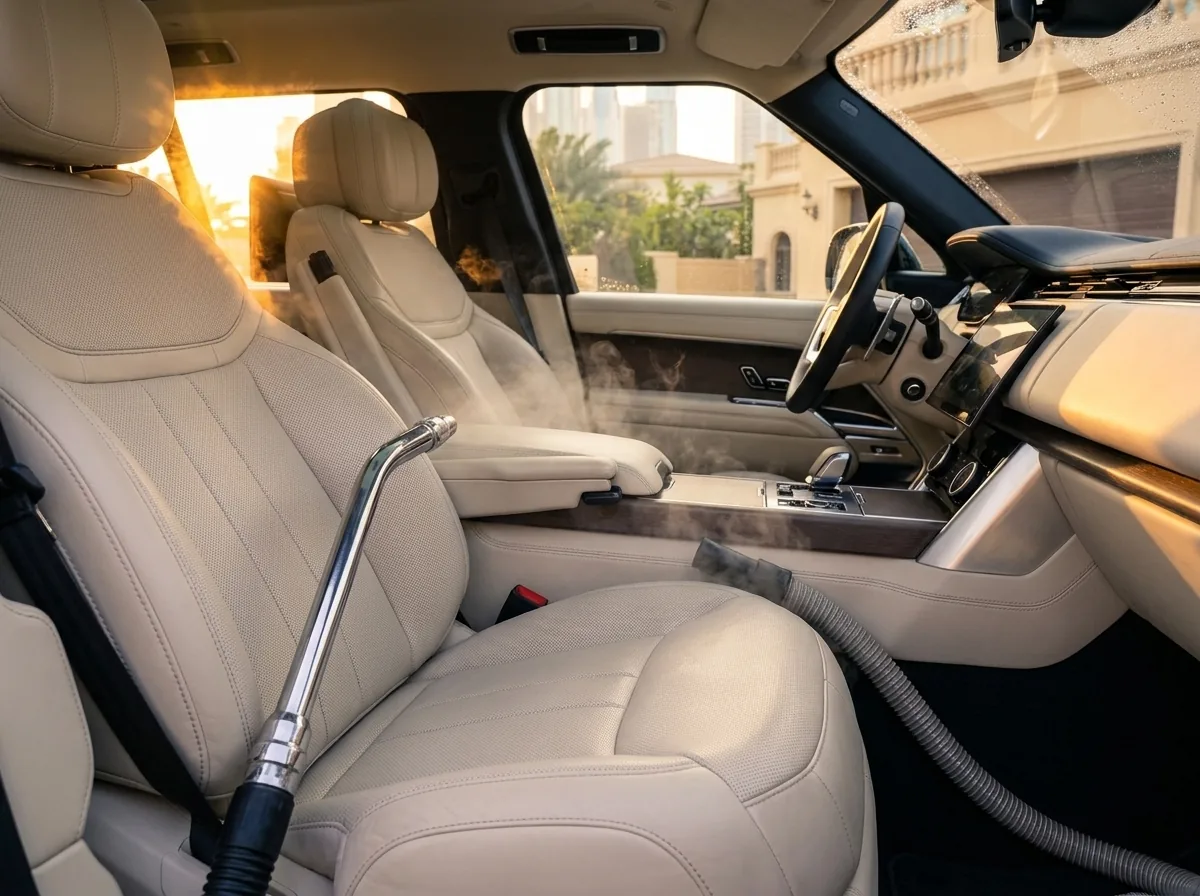
Steam, done right
Steam is safe in the right hands, and only there
Temperature control and material judgment decide everything. Interior deep cleans with steam from AED 549, at your door across Dubai.
Is steam cleaning safe for a car interior?
Yes, with two conditions attached. What keeps steam cleaning safe is temperature control and material judgment: regulated heat, the right distance from the surface, and an operator who knows which materials welcome steam and which merely tolerate it. Used that way, steam deep-cleans and sanitises fabric, vents and plastics without soaking them or leaving chemical residue. Used carelessly, the same vapour can stress leather, cloud screens and force moisture where electronics live. The tool is sound. The hands holding it are the variable.
What decides whether steam is safe?
Three settings, none visible on the invoice. Temperature: professional machines regulate it precisely, while cheap units swing between tepid and scorching. Distance and dwell: vapour held close to one spot concentrates heat that a moving, angled pass never builds up. And moisture volume: dry vapour lifts dirt for a towel to catch, whereas a wet blast just drives dirty water deeper into foam. Every horror story about steam damage traces back to one of those three being wrong. Every good result comes from all three being controlled, panel by panel, material by material.
The jobs steam does best
Steam is the right tool for the places brushes and cloths cannot honestly reach. Air vents, where dust mats onto the louvres and a directed pass lifts it out. Fabric seats and carpets, where hot vapour loosens ground-in dirt before extraction pulls it away. Seals, seams, cupholders, buckle recesses: the geography of a cabin that hoards grime. It also sanitises as it cleans, killing odour-causing bacteria with heat instead of masking them with perfume, which is why our steam wash service exists as its own booking for owners who want the cabin genuinely reset rather than freshened.
Is steam cleaning safe for leather?
With restraint, yes; with enthusiasm, no. Leather is skin, and prolonged heat and moisture stress it, dry it and, over repeated abuse, crack it. The professional approach is indirect: brief, low-intensity vapour to lift soiling, immediately towelled off, followed by a dedicated cleaner and conditioner so the hide keeps its oils. On aged or already-cracked leather we often skip steam entirely and work with products alone, a judgment made seat by seat rather than by rulebook. Our seat cleaning service pairs the methods, and the Seat & Leather Cleaning add-on at AED 199 covers the conditioning stage properly.
Screens and sensors: where steam never points
Modern cabins are electronics wearing upholstery. Infotainment screens, instrument glass, control panels, speaker grilles and the seams around modules are all places where forced vapour can push moisture somewhere expensive, and heat can cloud or delaminate a display. So steam never points at them. Screens get anti-static microfibre and screen-safe product; switchgear gets detailed with brushes barely damp enough to matter; grilles are cleaned dry. A cabin done properly is a map of methods, each surface getting the gentlest tool that works on it, and the steam machine spends most of the visit pointed at fabric, not technology.
Why temperature control is the whole difference
Because the gap between cleaning and damaging is measured in degrees and seconds. Professional steam equipment holds a set output steadily, so the operator can commit to a material-safe setting and keep it there for the whole cabin. Domestic and bargain units drift, spit condensate and surge when the tank runs low, which is how a safe pass on minute one becomes a scorch mark on minute forty. Add training, knowing what alcantara forgives that piano-black trim never will, and you have the actual product being purchased: not steam, which is everywhere, but control, which is not.
Does steam actually fix smells?
It fixes the smells that live on surfaces, because heat destroys the bacteria producing them, and that covers most cabin odours: food, spills, gym kit, general staleness. What steam cannot reach is a smell that has soaked the foam under the fabric or spread through the ventilation system. Smoke is the classic example. For those cases the honest answer is the Ozone Odour Removal add-on at AED 149, which treats the air and every cavity the air touches, after the steam work has removed the source material. Surface smell, steam; embedded smell, steam plus ozone. Anyone promising one tool for both is selling the tool.
Where does steam sit inside a deep clean?
In the middle of a longer sequence. Our interior deep cleaning, from AED 549 and running two to three hours, starts dry: full vacuum, sand shaken out of mats, debris cleared from seams. Steam then loosens what the vacuum could not lift, extraction pulls the dissolved dirt out of fabric, and dedicated products finish leather, plastics and glass. Everything is dried before handover. Steam alone is a technique; the deep clean is the system it belongs to, and the results people photograph come from the system.
Steam against extraction: choosing the tool
The two get confused because both attack fabric dirt. Steam is heat plus minimal moisture: ideal for sanitising, for surfaces that must not get wet, and for loosening grime. Extraction is flush and recover: detergent solution worked into the fibre and immediately vacuumed back out, which is what genuinely deep-cleans a seat soaked in years of use. A stained fabric seat wants extraction; a smelly but clean-looking one often wants steam; most real cabins want both in the right order. That choreography is the craft of interior cleaning, and it is why we quote from photos rather than from a menu alone.
How do we keep steam cleaning safe at your door?
The van makes the method portable without diluting it. Machine-regulated steam equipment runs off the van's own power, LED lighting shows what sunlight through a windscreen hides, and doors stay open for airflow while moisture-sensitive stages happen first so drying time is never squeezed. Materials get checked before methods get chosen: a hidden test spot on delicate surfaces, a conversation with you about anything already damaged or precious. And the cabin is handed back dry, because leaving damp foam inside a hot parked car is how a clean interior becomes a smelly one by the weekend.
Steam questions
Steam safety, answered
Can steam damage the dashboard?
Aimed directly and held close, it can stress the surface and the electronics behind it, which is why dashboards get a different method: brief indirect vapour at most, then microfibre and interior-safe product.
Is steam safe for child seats?
Steam is actually well suited to fabric child-seat surfaces because it sanitises without chemical residue. We clean around buckles and strap fittings carefully and let everything dry fully before the seat is used again.
Will the cabin be wet afterwards?
No. Dry-vapour technique uses far less water than people expect, and drying is a scheduled stage of the visit, never an afterthought. You get the car back ready to drive.
Does steam remove stains or just dirt?
It loosens both, and extraction then pulls the stain material out of the fibre. Some dye-based stains are permanent whatever the tool; we tell you which is which when we see them.
Is steam cleaning included in the AED 549 deep clean?
Steam is one of the tools the deep clean draws on wherever the cabin needs it, alongside vacuuming, extraction and material-specific products. You are booking the result, and the tools follow the car.
Can you steam-clean the engine bay too?
We offer Engine Bay Cleaning as a fixed add-on at AED 149, done with appropriate methods for a compartment full of electronics. It is a separate discipline from interior steam work, with its own precautions.
Professional steam, professional judgment
Send photos of the cabin on WhatsApp. You get a straight answer on method, a fixed price, and a dry, sanitised interior at your door.